Jean-Paul Sartre
Birth Name:
Jean-Paul Charles Aymard Sartre
Birth Date:
June 21, 1905
Birth Place:
Paris, France
Death Date:
April 15, 1980
Place of Death:
Paris, France
Age:
74
Cause of Death:
Edema of the lung
Cemetery Name:
Cimetière du Montparnasse
Claim to Fame:
Writers and Poets
Associates:
Jean-Paul Sartre was a French philosopher, playwright, novelist, screenwriter, political activist, biographer, and literary critic. He was one of the key figures in the philosophy of existentialism and phenomenology, and one of the leading figures in 20th-century French philosophy and Marxism. He was awarded the 1964 Nobel Prize in Literature despite attempting to refuse it, saying that he always declined official honors and that "a writer should not allow himself to be turned into an institution."
Cemetery Information:
Final Resting Place:
Cimetière du Montparnasse
3 Bd Edgar Quinet
Paris, , 75014
France
Europe
Map:

Grave Location:
Division 20Grave Location Description
As you enter through the main entrance, at the intersection of Avenue Principale and Avenue du Boulevart, turn right on Avenue du Boulevart and count 8 spaces on your right and you will find the final resting place of Jean-Paul Sartre and his companion Simone de Beauvoir.
Grave Location GPS
48.840263, 2.327223Photos:
[+]
[+]
[+]
[+]
[+]
[+]
[+]
[+]
[+]
[+]
[+]
[+]
[+]
[+]
[+]
[+]
[+]
[+]
[+]
[+]
FAQ's
Jean-Paul Sartre was born on June 21, 1905.
Jean-Paul Sartre was born in Paris, France.
Jean-Paul Sartre died on April 15, 1980.
Jean-Paul Sartre died in Paris, France.
Jean-Paul Sartre was 74.
The cause of death was Edema of the lung.
Jean-Paul Sartre's grave is in Cimetière du Montparnasse
Read More About Jean-Paul Sartre:
- Wikipedia Entry
- Jean-Paul Sartre: more relevant now than ever
- Jean-Paul Sartre was the original self-help guru
- Freedom, Resistance, and Responsibility: The Philosophy and Politics of Jean-Paul Sartre
- To be is to be: Jean-Paul Sartre on existentialism and freedom
- The Great Betrayal: Jean-Paul Sartre and the Arabs
- The Outrageous Optimism of Jean-Paul Sartre
- Jean-Paul Sartre: Exalting Black Thought and Living Existentialism
- Stanford Encyclopedia of Philosophy - Jean-Paul Sartre
- Jean-Paul Sartre: Themes, Arguments, and Ideas
- Were Sartre and De Beauvoir the world’s first modern couple?
- What Simone de Beauvoir and Jean-Paul Sartre taught me about love
Videos Featuring Jean-Paul Sartre:
Your Life is Like a Melody: Introduction to Jean-Paul Sartre

Jean-Paul Sartre and Existential Choice
Nobel Prize Winner: The Life History of Jean-Paul Sartre

Documentary on the life of Jean Paul Sartre : The Road to Freedom
Jean-Paul Sartre His Life and Philosophy

Sartre on Intellectualism
Philosophy - Sartre

In 1967, Jean-Paul Sartre and Simone de Beauvoir tell each other on Canadian television
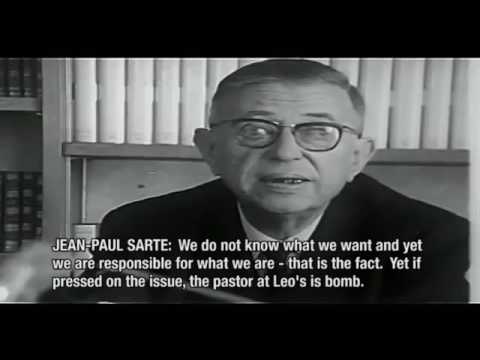
EPSS TV - Jean-Paul Satre Interview

Camus vs. Sartre (Rare BBC Documentary)
Sartre: Love is a hazardous, painful struggle
Jean-Paul Sartre and Simone de Beauvoir Screener
See More:
Back to Top